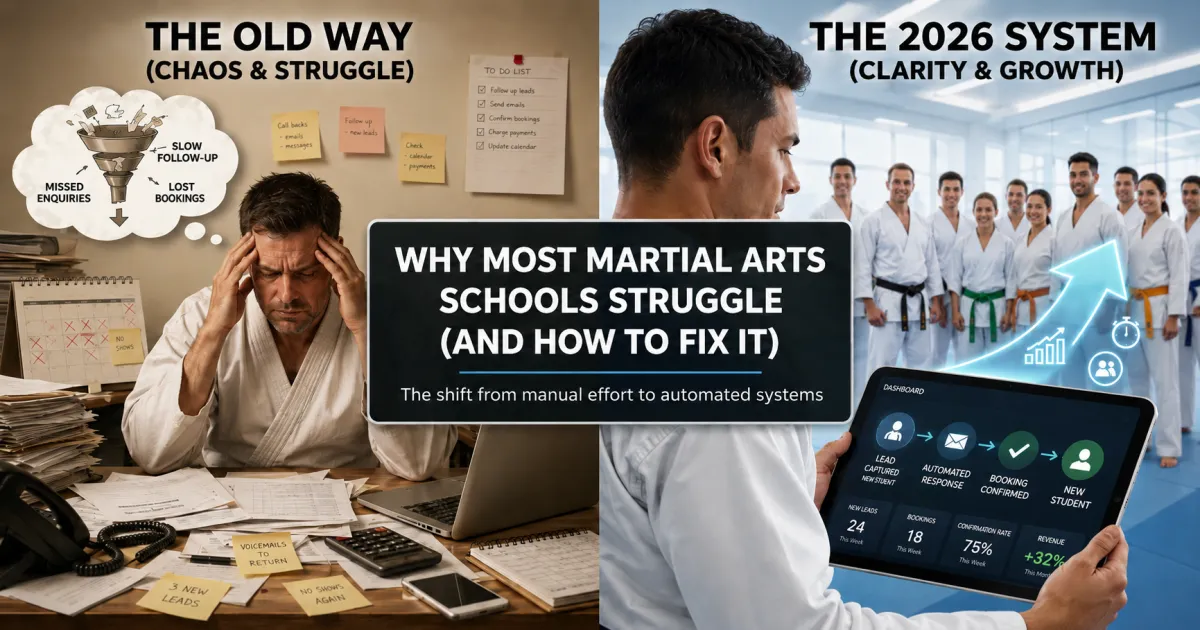
Why Most Martial Arts Schools Struggle to Get New Students (And How to Fix It in 2026)
By David Lowe
What’s in this blog
Why most schools stall, the real marketing bottleneck, the system modern schools need, and what to fix first.
If you run a martial arts school and getting new students feels harder than it should, you’re not imagining it.
I’ve seen this pattern repeat itself again and again. Good schools. Great instructors. Strong communities. Yet enrolments feel inconsistent, unpredictable, or completely reliant on bursts of effort that leave the owner exhausted.
The problem is rarely effort. And it’s almost never the quality of the martial arts.
The problem is the system behind how new students are discovered, contacted, followed up, and booked.
And in 2026, that system matters more than ever.
The uncomfortable truth most school owners avoid
Most martial arts schools don’t actually have a marketing system.
What they have is a collection of disconnected activities.
A website built years ago. A Facebook page that’s updated when there’s time. Messages answered when someone notices them. Leads written down, remembered, or followed up “later”.
From the outside, it looks like marketing is happening. From the inside, it feels chaotic.
Here’s the key thing most owners don’t realise until it’s pointed out to them.
Marketing doesn’t fail because you’re not doing enough. It fails because nothing is connected.

Why effort without structure always burns you out
I’ve worked with school owners who post every day, reply to messages late at night, run open days, give out free trials, and still feel like they’re chasing their tail.
They’re busy. They’re committed. They’re doing the work.
But they’re doing it manually.
Every enquiry relies on someone seeing it, someone responding, someone remembering to follow up, someone booking it correctly, and someone confirming attendance.
Miss one step and the lead quietly disappears.
This is why schools say things like “We get enquiries but they don’t show up”, “We had loads of interest but it went quiet”, or “I think people message us and then forget”.
They don’t forget. The system fails them.
Speed-to-lead is no longer optional
One of the biggest shifts I’ve seen in the last few years is how quickly expectations have changed.
Parents and adult beginners now expect immediate acknowledgement.
Not tomorrow. Not later that evening. Immediately.
If someone enquires about classes and doesn’t hear back quickly, one of two things happens. They enquire somewhere else, or they lose momentum and don’t book at all.
Speed-to-lead isn’t about being pushy. It’s about being present at the moment of interest.
Without automation, that speed is impossible to maintain consistently.

Why disconnected tools quietly kill growth
Most schools use multiple platforms that don’t talk to each other.
Website forms that send emails. Facebook messages answered manually. Calendars that require back-and-forth. Spreadsheets or notebooks for tracking leads.
Each tool works on its own. Together, they create friction.
Every handoff is a chance for delay, confusion, missed follow-up, or lost trust.
This is where schools unknowingly leak students. Not because people said no, but because nobody guided them to a clear next step.
The system modern martial arts schools actually need
High-performing schools aren’t doing more marketing. They’re doing smarter marketing.
They have one connected system that captures every lead automatically, responds instantly, follows up consistently, guides people to book, confirms attendance, and tracks outcomes.
Nothing relies on memory. Nothing relies on motivation. Nothing relies on “when I get a chance”.
This is where automation stops being a luxury and becomes infrastructure.
Where AI fits into this (and where it doesn’t)
AI isn’t here to replace instructors or relationships. It’s here to remove friction.
Used properly, AI helps respond faster, handle common questions, route leads correctly, support follow-up, and surface data you’d otherwise miss.
The schools that will struggle in 2026 aren’t the ones who avoid ads. They’re the ones still relying on manual systems while expectations keep rising.

What to fix first if this feels familiar
If any of this sounds uncomfortably accurate, don’t try to fix everything at once.
The first fix is always the same. Create one clear, connected journey from enquiry to booking.
That means one place where leads land, one automated response path, one booking action, and one follow-up sequence.
Once that exists, everything else becomes easier. Content works better. Ads work better. Referrals work better. Your time comes back.
The schools that win aren’t louder, they’re clearer
The biggest shift I’ve seen isn’t in tactics. It’s in clarity.
Schools that grow consistently have clear systems, clear follow-up, clear expectations, and clear next steps.
They don’t rely on hope. They don’t rely on memory. They don’t rely on hustle.
They rely on structure.
And once that structure is in place, growth stops feeling stressful and starts feeling predictable.


